Morocco is a big country, but its wine lives in a surprisingly narrow band. Draw a rough line from the Atlantic coast near Casablanca inland to the Middle Atlas foothills around Meknès, and you have captured the great majority of the vines. Everything worth knowing about Moroccan wine geography comes down to two forces pulling in opposite directions: the heat of a country that sits on the edge of the Sahara, and the cool relief that comes from altitude and the Atlantic. The best wines are the ones that find that relief.
Here is the land, region by region.
Meknès and Guerrouane: the plateau that runs the show
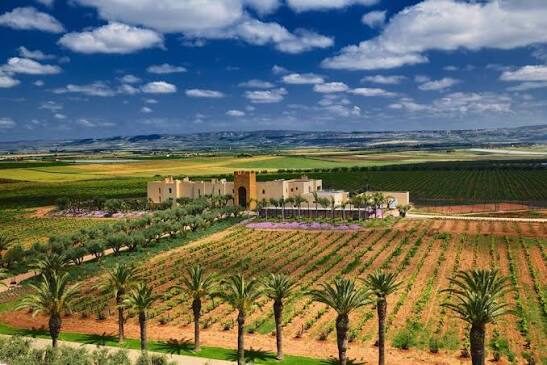
If Moroccan wine has a capital, it is Meknès. The city sits on a plateau in the Middle Atlas foothills where vineyards climb from roughly 500 up toward 800 meters, and that elevation is the whole story. Daytime heat ripens the grapes fully, then the altitude drops the temperature sharply after dark, and those cold nights are what let a grape like Syrah hold onto its pepper, its floral lift, and its acidity instead of baking into jammy flatness.
This zone, taking in the Guerrouane and Beni M’tir appellations, produces well over half of Morocco’s wine. It is home to Les Celliers de Meknès, the country’s dominant producer, and to Château Roslane, the estate that in 2008 earned Morocco’s first official “Château” status and sits inside the higher AOC Coteaux de l’Atlas. Just north, Domaine de la Zouina farms vines at around 800 meters and bottles its well-regarded Volubilia and Epicuria labels, a project revived by two French brothers who brought Bordeaux experience from Pessac-Léognan. If you taste one region’s wines, taste these.
Fès, Saïss and Zerhoune: the historic heart
Wrapped around Meknès are the Saïss basin and the slopes of Mount Zerhoune, near the Roman ruins of Volubilis where wine was pressed almost two thousand years ago. The Zerhoune and Saïss AOG zones share the plateau’s warm days and cool nights. This is where you find smaller, tourism-friendly estates such as Villa Volubilia, a family winery that pairs its tastings with a Moroccan lunch and the extraordinary backdrop of Volubilis itself. It is the most rewarding corner of the country to actually visit.
The Atlantic corridor: Rabat, Benslimane, El Jadida
Follow the coast south from Rabat toward Casablanca and El Jadida and the influence flips from altitude to ocean. Morning fog and cooling Atlantic breezes lengthen the growing season here, which favors lighter reds, crisp whites, and the pale vin gris that Morocco sells by the tanker. The Sahel and Doukkala areas around El Jadida, and the Benslimane hills inland of Casablanca, are workhorse zones feeding the big commercial brands. The AOC Les Côtes de Rommani, inland toward Rommani, is the coast’s answer to Coteaux de l’Atlas, a demarcated zone for higher-ambition wine.
Boulaouane and the vin gris country
Southwest of Casablanca, the Boulaouane area gave its name to Morocco’s most famous everyday wine: Gris de Boulaouane, the salmon-pink, bone-dry vin gris that is the best-selling wine in the country. It is uncomplicated and, well chilled on a hot afternoon, genuinely lovely. Do not judge Moroccan wine by it, but do not look down on it either.
The edges: Essaouira, the East, and the South
Two outliers are worth your attention. On the Atlantic at Essaouira, Domaine du Val d’Argan, founded by a winemaker from the southern Rhône, farms Rhône varieties (Grenache, Syrah, Mourvèdre, and white Roussanne and Marsanne) in sandy coastal soils, making some of the most distinctive wine in the country. Far to the east near Oujda, the Angad and Berkane zones bake in a hotter, more continental climate that suits robust reds. These are not where most Moroccan wine comes from, but they are where some of its most interesting wine comes from.
How the appellation system works
Morocco borrowed its framework from France. At the top sit two AOC appellations, Coteaux de l’Atlas (in the Meknès highlands) and Les Côtes de Rommani (inland from the coast), which carry the strictest rules on yield and origin. Below them are fourteen AOG appellations, an “origin guaranteed” tier covering zones such as Guerrouane, Beni M’tir, Zerhoune, Saïss, Sahel, Zemmour, Gharb, and Angad. In practice the label tells you two useful things: an AOC bottle is aiming higher, and the appellation name tells you whether you are drinking altitude or coast. The full guide to Moroccan appellations breaks down every zone.
Where to go next
Now that you know the map, meet the grapes that grow on it, browse the producers shaping each zone, or start planning a visit to the vineyards.
Related: vin gris, Morocco’s grey wine, and the best Moroccan wine brands and bottles from these regions.