Last updated: 8 November 2026. Tasting descriptions come from the producer, and prices are shown in the seller’s currency and can change. No affiliate links are used.
Gris de Boulaouane is a pale Moroccan wine, not a grape variety. The brand’s own website describes its gris as a Cinsault–Grenache wine made by direct pressing with very brief skin contact. Boulaouane also has a red Cabernet Sauvignon–Merlot wine: the shared brand name does not mean the two are the same colour, blend or style.
Start with the words on the bottle. “Boulaouane,” “gris,” “rosé,” “rouge” and “Domaine de Khmis” answer different questions, and merchants do not always organise them consistently. A category heading is less useful than an exact product name and label photograph.
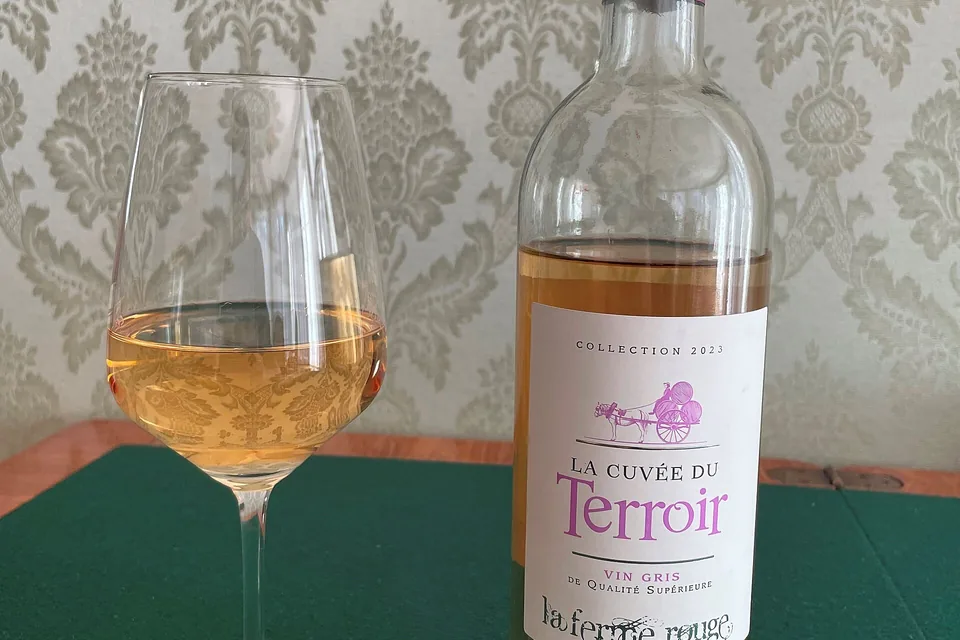
Illustration: a glass of Moroccan vin gris.
Gris versus rouge: the basic distinction
| Label wording | Brand’s description | How to use the information |
|---|---|---|
| Boulaouane Gris / Cinsault Grenache | Pale pink colour; direct pressing; Cinsault and Grenache | Look for the colour, grapes and actual bottle; do not assume “gris” is a separate grape |
| Boulaouane Rouge / Cabernet Sauvignon Merlot | Red wine combining those two varieties | A distinct red, not another name for the pale gris |
| Boulaouane Gris Rosé – Domaine de Khmis | Wording on Nicolas’s current 75cl listing | A specific merchant catalogue identity, not proof of a separate legal appellation |
The brand’s own page supports the first two descriptions. Its general text places the vineyards in the Doukallas region south of Casablanca. Merchants sometimes give a different region.
Why a gris may appear under rosé
The producer describes the gris’s very light colour as the result of direct pressing after destemming, with only brief contact between skins and juice. It is still described as pale pink. The word “grey” does not mean the drink is literally grey or that grey grapes are required in every wine with this style name.
Nicolas lists its Boulaouane as Gris Rosé, and Mabouteille calls its product Rosé Boulaouane while describing it as vin gris. Those listings show how a retail colour category and a traditional style term can overlap.
Use our vin gris explainer for the broader production/style question; this page is about recognising the Boulaouane bottle.
Grapes: use the specific wine, not the whole brand
The official description lists Cinsault and Grenache for the gris, and Cabernet Sauvignon and Merlot for the rouge. It doesn’t give percentages or a vintage, so the blend may vary from year to year.
Some secondary descriptions add other grapes or use another regional taxonomy. The brand’s own description and the bottle’s label are the best guide. The same caution applies to a different Boulaouane product: a rosé in a separate trade portfolio is not automatically the exact gris on the shelf in front of you.
Read the back label for vintage, origin wording, bottler and ingredients/allergens relevant to your bottle. A website description does not replace that physical product information.
What does it taste like?
The brand describes the gris with fresh-fruit, floral and honey-like aromatic notes. These are the producer’s own descriptions. Honey in a tasting note does not establish a measured sugar level or mean that honey was added.
The producer describes the rouge as combining Merlot’s roundness with Cabernet Sauvignon’s structure, with red-fruit and spice notes. Vintages can taste different.
The useful buying distinction is between a pale gris and a red blend. Decide which style fits the meal and your preference, then ask the merchant about the actual vintage.
Serving and food: what the source recommends
The brand recommends 10–12°C for the gris and 16–18°C for the rouge. These are serving suggestions, not strict rules. Some merchants suggest a cooler range for the gris; follow the actual bottle and adjust for your preference and the room.
Its suggested partners for the gris include Mediterranean dishes, grilled fish/meat and salads. Choose by the sauce, heat and sweetness of the dish rather than simply by its nationality.
For the red, the producer suggests red meats and spiced dishes. Avoid treating “spiced” as a guarantee that a tannic red suits very hot chilli or every sweet fruit sauce. The food-pairing hub covers those choices in more detail.
Where to buy in France
| Merchant / listing | Displayed example on 8 November 2026 | Caveat |
|---|---|---|
| Nicolas: Boulaouane Gris Rosé – Domaine de Khmis | 75cl, €7.70; page displays 12% vol | Confirm current bottle, local stock and delivery; category text alone does not guarantee fulfilment |
| Mabouteille: Rosé Boulaouane | 75cl, displayed €16; page offers personalisation | A personalised-bottle context, not a like-for-like ordinary shelf-price benchmark |
Sources: Nicolas’s Morocco selection and Mabouteille’s product page. Prices exclude delivery and vary between shops.
Nicolas’s stock labels don’t guarantee availability at your store or postcode. Mabouteille’s customisation offer explains why its displayed product should not be compared blindly with a standard bottle. Delivery, quantity and any options can change the total.
Buying elsewhere, and what to ask for
For Morocco, use the licensed-shop hub, not an assumption that every supermarket carries this brand. For the UK or USA, use our UK and US guides as market-specific starting points; they do not guarantee Boulaouane stock.
Ask for the full product name, colour, vintage if present, bottle size, actual label and delivery destination. If a shop proposes another Moroccan gris, that may be a useful alternative style, but it is not the same product merely because both are pale.
Never infer a customs allowance or airline packing rule from a merchant listing. Those are separate travel questions and require current official guidance. The visitor-rules guide explains the distinction.
Boulaouane, Guerrouane and vin gris are not interchangeable terms, and a merchant’s “appellation” field isn’t an official designation.
For a wider choice of bottles, see the Moroccan bottle shortlist.
Frequently asked questions
Is Boulaouane a grape?
No. It is a brand and wine name. The gris description identifies Cinsault and Grenache; the rouge identifies Cabernet Sauvignon and Merlot.
Is Gris de Boulaouane red or white?
The producer describes a pale pink gris made by direct pressing. Retailers may categorise it as rosé. It is distinct from Boulaouane Rouge.
Does “honey” in the description mean it is a sweet wine?
Not by itself. An aroma descriptor does not establish residual sugar. Ask for the exact bottle’s technical information if sweetness matters to you.
How much does it cost?
The two dated French examples above describe different retail contexts. Check the actual bottle and the delivered total.
Sources
Brand and merchant pages linked above, as of 8 November 2026. For more prices, see the price guide.